He speaks in an eloquent manner. The accent is unmistakably British, although at times during our conversation there are traces of Uncle Sam’s English. His gentility is palpable, the well-trimmed salt and pepper bristles below a shiny pate giving him a distinguished look.
I catch Waris Hussain, Lucknow-born, US-based producer-director in an ebullient mood at his London apartment. Reason? His new film Trying to Grow, based on Firdaus Kanga’s novel of the same name, has just been shown to one of the committee members of the Cannes film festival. “And he actually sat through the whole film totally engrossed.” The indications are clear. Cannes beckons.
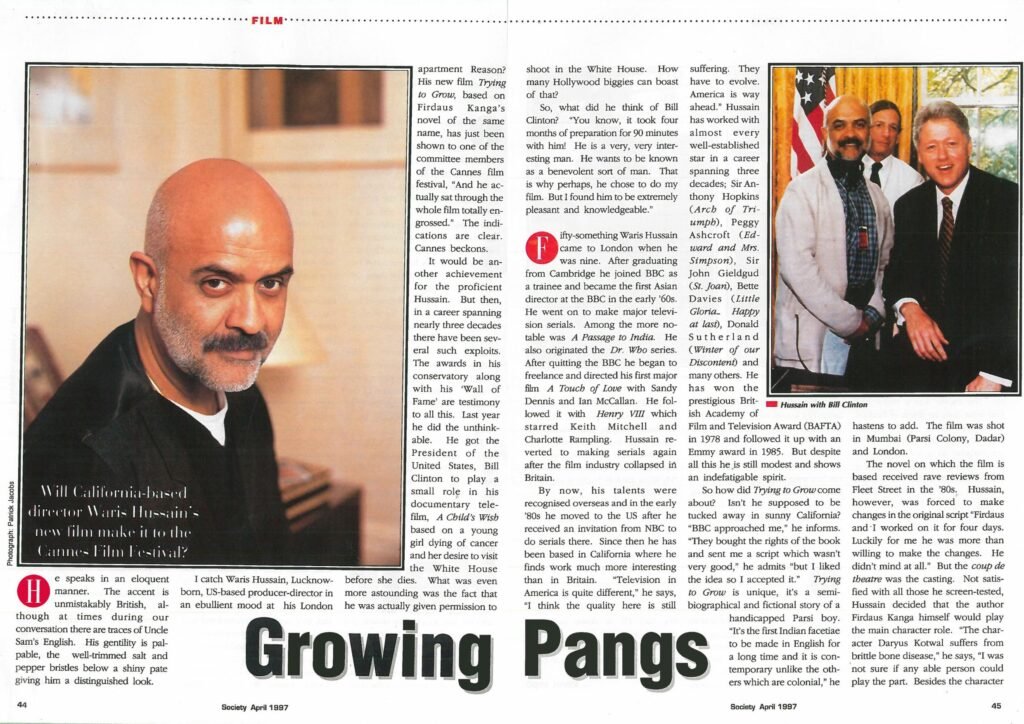
It would be another achievement for the proficient Hussain. But then, in a career spanning nearly three decades, there have been several such exploits. His awards in the conservatory along with his ‘Wall of Fame’ are testimony to all this. Last year, for instance, he had the able. He got the President of the United States, Bill Clinton to play a small role in his documentary feature film, A Child’s Wish — the story of a 16-year-old girl dying of cancer and her desire to visit the White House before she dies. What was even more astounding was the fact that he was actually given permission to shoot in the White House. How many Hollywood biggies can boast of that?
So, what did he think of Bill Clinton? “You know, it took four months of preparation for 90 minutes with him. He is a very, very interesting man. He went to see me known as a benevolent sort of man. That is why perhaps, he chose to do my film. But I found him to be extremely pleasant and knowledgeable.”
Fifty-something Waris Hussain came to London when he was nine. After graduating from Cambridge he joined BBC as a trainee and became the first Asian director at the BBC at the age of 21. He went on to make major television serials. Among the more notable was A Passage to India. He also originated the Dr. Who series. After quitting the BBC he began to freelance and directed plays like A Touch of Love with Sandy Dennis and Ian McCallan. He worked in Henry VIII which starred Keith Mitchell and influenced the filming. Hussain returned to making serials again for the film industry as well as for Britain.
Now his attentions were claimed by television. In the ’80s he moved to the US after he had from an invitation from NBC to do a series on Indian women who were based in California where he now lives. “Much of TV is competition in Britain. ‘Television America is quite different,” he says, “I think the quality here is still suffering. They have to evolve. America” is way head.’ Hussain has worked with several well-established star in a career spanning three decades; Sir Anthony Hopkins (Arch of Triumph), Peggy Ashcroft (Bedazzled and Mrs. Simpson), Sir John Gielgud (St. Joan), Bette Davis (Gloria), Happy as cloud, Donald Sutherland (The Winter of Discontent) and many others. He has won the British Academy of Film and Television Award (BAFTA) in 1978 and two Emmy awards in 1985. But despite all the adulation he is still an indefatigable spirit.
The new film Trying to Grow comes to a touch he is especially tucked away in sunny California. “BBC approached me in the early ’80s to do this film but it did not work and me the script wasn’t right.” So I accepted Trying to Grow is unusual. “It is different from my usual films,” says Hussain, who shuttles between Mumbai (Parsi Colony, Dadar) and London.
Based on the novel, the film is plotted in which the film is laid. Hussain reserves rave reviews from Fleet Street in the ’80s, Hussain, insists the original script “Firdaus and I worked for almost four days. In the end he was the one who was willing to make all the changes. He helped me a lot.” He was impressed that his caste screen-tested, as much. “Not satisfied was he about the hero until he realised that Firdaus Kanga himself who was puny. Editor Daryoush Kotval suffers from a brittle bone disease, “Yes, I was worried not handicap any person could play the part. Besides the character spans almost ten years and it would be difficult to find two people to give different ages to play that kind of role. Firdaus is physically small. I’ve got him to play the character from 8 to 18,” he says. But will the audience accept it? “I hope so. I hope we managed to pull it through.” And then un-ashamedly admits, “I was inspired by a German film called Tin Drum where an adult is caught in a body of an eight-year-old and never grows even as years pass by. The movie was a major hit.”
And what does he think of Firdaus’ acting capabilities. “Oh! He’s terrific. I think he’s going to be a big surprise to a lot of people.” The other characters were chosen from Mumbai and London theatre.
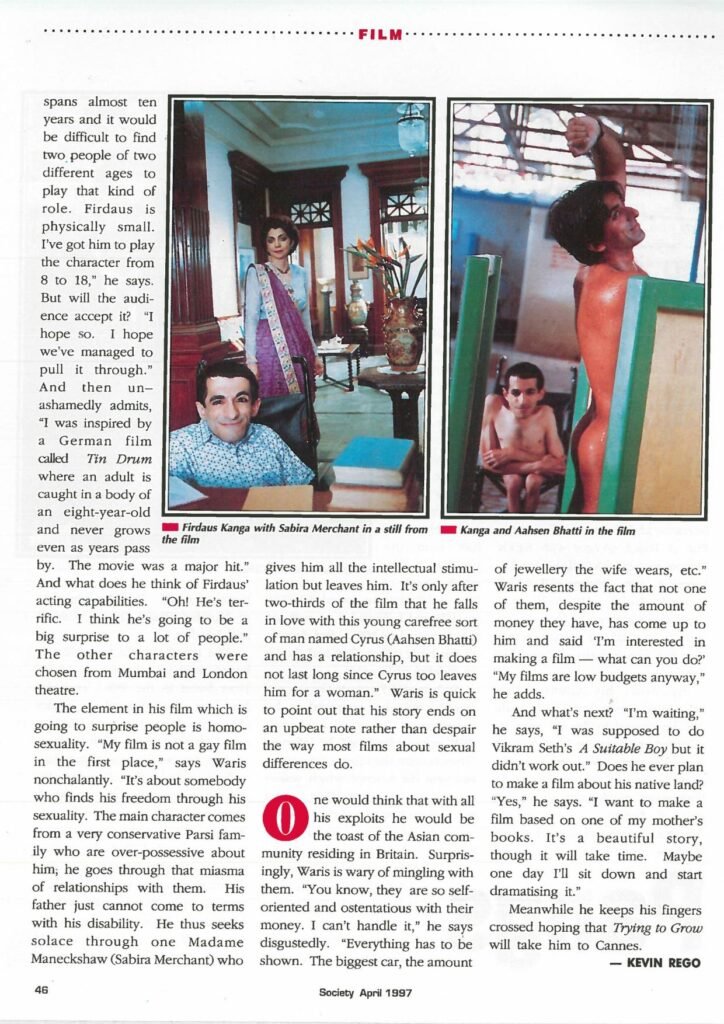
The element in his film which is going to surprise people is homosexuality. “My film is not a gay film in the first place”, says Waris unchalantly. “It’s about somebody who finds his freedom through his sexuality. The main character comes from a very conservative Parsi family who are over-possessive about him, he goes through this amazing of relationships with them. His father just cannot come to terms with his disability. He seeks solace through one Madame Moneschkat (Sabira Merchant) who gives him all the intellectual stimulation but leaves him. It’s only after two-thirds of the film that he falls in love with this young carefree sort of man named Cyrus (Salim Raza) and has a relationship, but it does not last long since Cyrus too leaves him for a woman.” Waris is quick to point out that his story ends in an upbeat note rather than focuses in the way most films about sexual differences do.
One would think that with all his exploits he would be living the coast of the Asian community residing in Britain. Surprisingly, Waris is wary of Indian systems. “You know, they are so self-oriented and ostentatious with money. I can’t handle it,” he says disgustedly. “Everything has to be shown. The biggest car, the amount of jewellery the wife wears, etc.” Waris resents the fact that in India, despite the amount of money they have, has come to a stand-still in terms of making a film — what can you do within two hours?” he says.
And what’s next? “I’m waiting,” he adds.
Waris is enjoying the success of Vikram Seth’s A Suitable Boy to be made into a film.
“Yes,” he says. “I want to make a film based on the book’s themes. It is a beautifully moving book. It will take time. Maybe shortly I will start dramatizing it.”
Meanwhile he keeps his fingers crossed hoping that Trying to Grow will take him to Cannes.
— KEVIN REGO