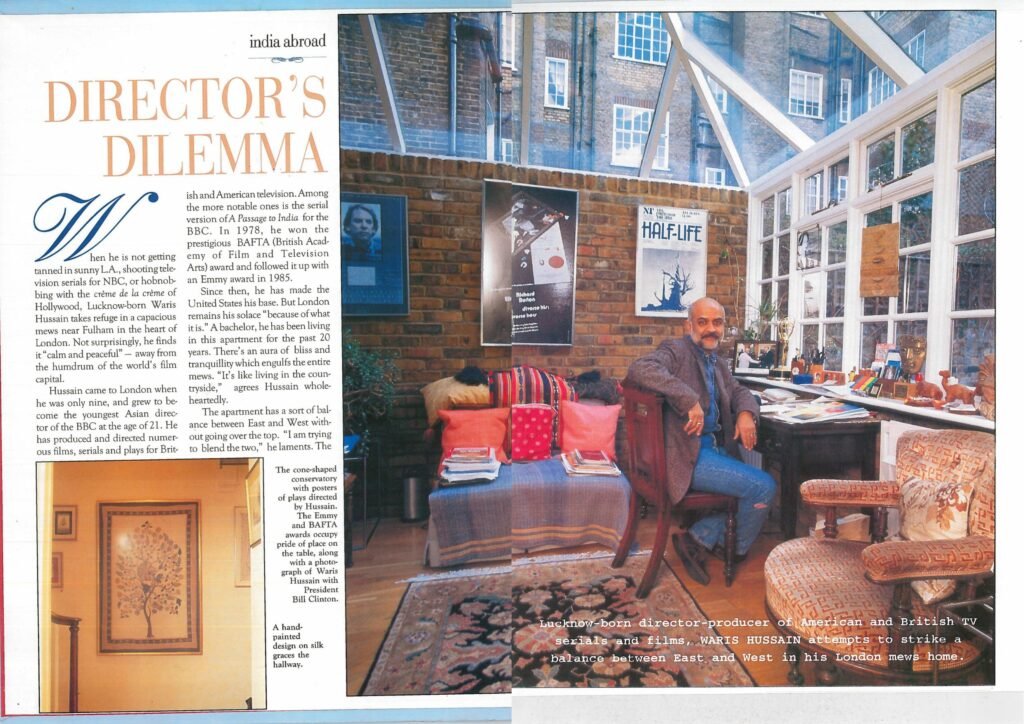
When he is not getting tanned in sunny L.A., shooting television serials for NBC, or hobnobbing with the crème de la crème of Hollywood, Lucknow-born Waris Hussain takes refuge in a capacious mews near Fulham in the heart of London. Not surprisingly, he finds it “calm and peaceful” — away from the humdrum of the world’s film capital.
Hussain came to London when he was only nine, and grew to become the youngest Asian director of the BBC at the age of 21. He has produced and directed numerous films, serials and plays for British and American television. Among the more notable ones is the serial version of A Passage to India for the BBC. In 1978, he won the prestigious BAFTA (British Academy of Film and Television Arts) award and followed it up with an Emmy award in 1985.
Since then, he has made the United States his base. But London remains his solace “because of what it is.” A bachelor, he has been living in this apartment for the past 20 years. There’s an aura of bliss and tranquillity which engulfs the entire mews. “It’s like living in the countryside,” agrees Hussain wholeheartedly.
The apartment has a sort of balance between East and West without going over the top. “I am trying to blend the two,” he laments. The cone-shaped conservatory with posters of plays directed by Hussain. The Emmy and BAFTA awards occupy pride of place on the table, along with a photograph of Waris Hussain with President Bill Clinton.
A hand-painted design on silk graces the hallway.
Lucknow-born director-producer of American and British TV serials and films, WARIS HUSSAIN attempts to strike a balance between East and West in his London mews home.
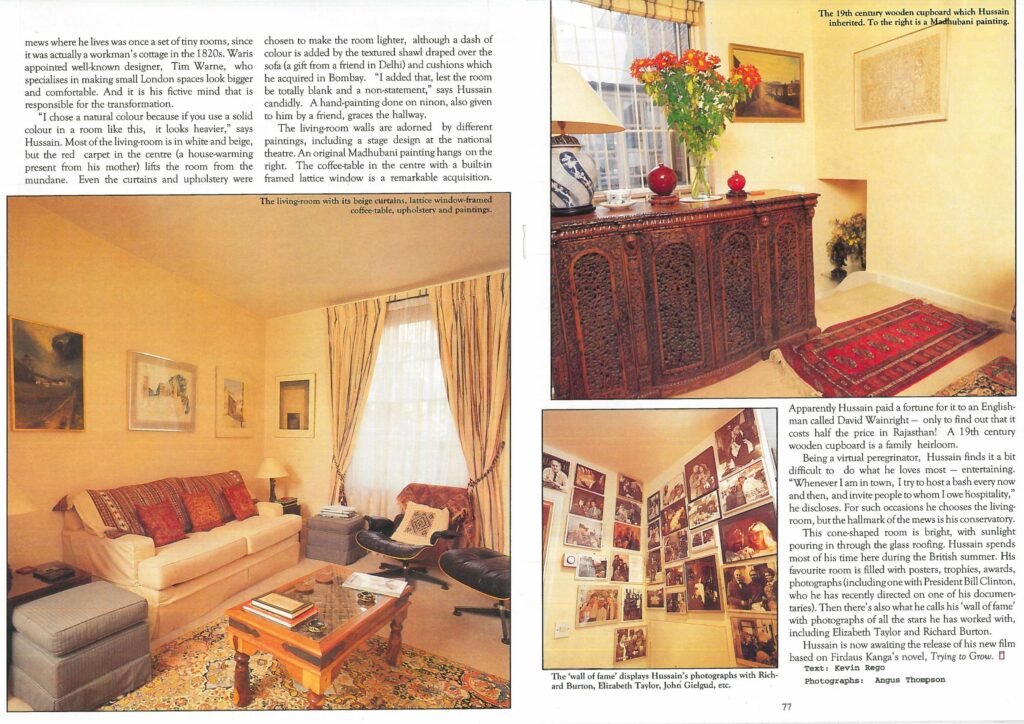
The mews where he lives was once a set of tiny rooms, since it was actually a workman’s cottage in the 1820s. Waris appointed well-known designer Tim Warne, who specialises in making small London spaces look bigger and comfortable. And it is his fictive mind that is responsible for the transformation.
“I chose a natural colour because if you use a solid colour in a room like this, it looks heavier,” says Hussain. Most of the living-room is in white and beige, but the red carpet in the centre (a house-warming present from his mother) lifts the room from the mundane. Even the curtains and upholstery were chosen to make the room lighter, although a dash of colour is added by the textured shawl draped over the sofa (a gift from a friend in Delhi) and cushions which he acquired in Bombay. “I added that, lest the room be totally blank and a non-statement,” says Hussain candidly. A hand-painting done on ninon, also given to him by a friend, graces the hallway.
The living-room walls are adorned by different paintings, including a stage design at the national theatre. An original Madhubani painting hangs on the right. The coffee-table in the centre with a built-in framed lattice window is a remarkable acquisition.
The 19th-century wooden cupboard which Hussain inherited. To the right is a Madhubani painting.
Apparently Hussain paid a fortune for it to an Englishman called David Wainwright — only to find out that it costs half the price in Rajasthan! A 19th-century wooden cupboard is a family heirloom.
Being a virtual peregrinator, Hussain finds it a bit difficult to do what he loves most — entertaining. “Whenever I am in town, I try to host a bash every now and then, and invite people to whom I owe hospitality,” he discloses. For such occasions he chooses the living-room, but the hallmark of the mews is his conservatory.
This cone-shaped room is bright, with sunlight pouring in through the glass roofing. Hussain spends most of his time here during the British summer. His favourite room is filled with posters, trophies, awards, photographs (including one with President Bill Clinton, who he has recently directed on one of his documentaries). Then there’s also what he calls his “wall of fame’’ with photographs of all the stars he has worked with, including Elizabeth Taylor and Richard Burton.
The ‘wall of fame’ displays Hussain’s photographs with Richard Burton, Elizabeth Taylor, John Gielgud, etc.
Hussain is now awaiting the release of his new film based on Firdaus Kanga’s novel, Trying to Grow.
Text: Kevin Rego
Photographs: Angus Thompson