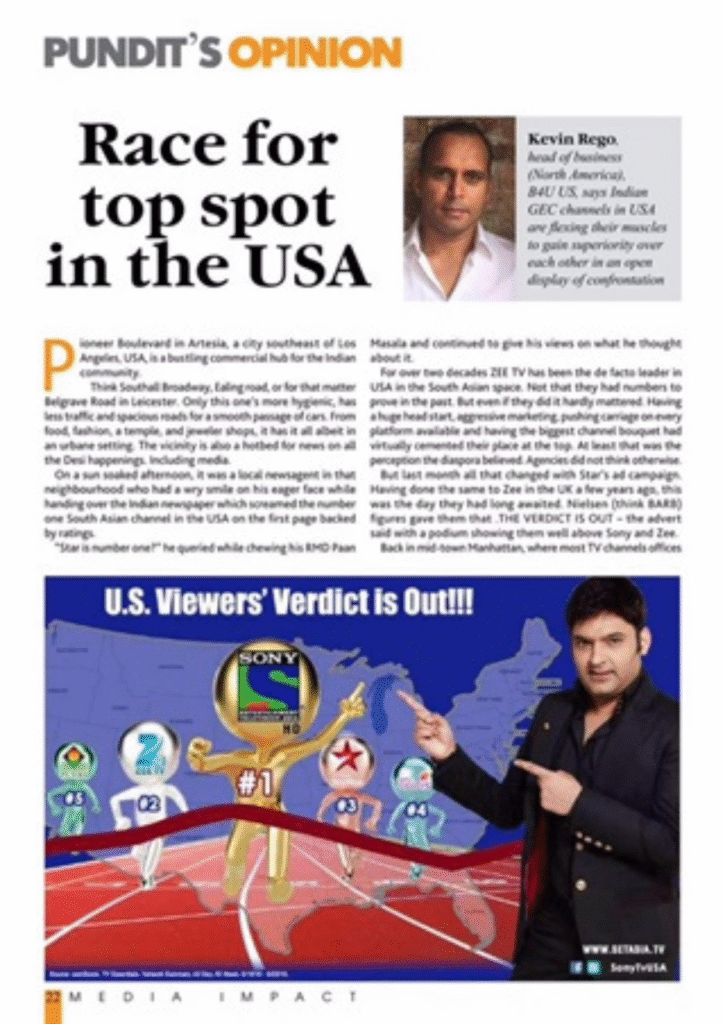
Indian channels in USA are flexing their muscles to gain superiority over each other in an open display of confrontation
By Kevin Rego
MEDIA IMPACT MAGAZINE 2018
Pioneer Boulevard in Artesia, a city southeast of Los Angeles, USA, is a bustling commercial hub for the Indian community. Think Southall Broadway, Ealing road, or for that matter Belgrave Road in Leicester. Only this one’s more hygienic, has less traffic and spacious roads for a smooth passage of traffic. From food, fashion, a temple, and jeweler shops, it has it all albeit in an urbane setting. The vicinity is also a hotbed for news on all the Desi happenings. Including media.
On a sun soaked afternoon last month, it was a local newsagent in that neighbourhood who had a wry smile on his eager face while handing over the Indian newspaper which screamed the number one South Asian channel in the USA on the first page backed by ratings. ”Star is number one?” he queried while chewing his RMD Paan Masala and continued to give his views on what he thought about it.
For over two decades ZEE TV has been the de facto leader in USA in the South Asian space. Not that they had numbers to prove in the past. But even if they did it hardly mattered. Having a huge head start, aggressive marketing, pushing carriage on every platform available and having the biggest channel bouquet, had virtually cemented their place at the top. Atleast that was the perception. The diaspora believed. Agencies did not think otherwise.
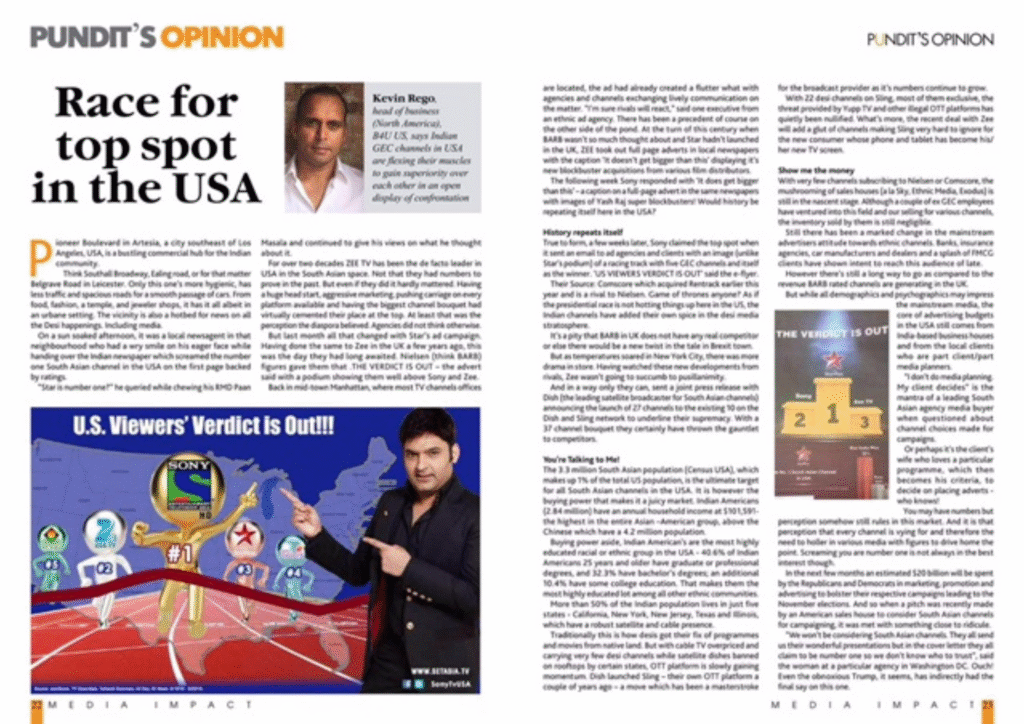
But last month all that changed with Star’s ad campaign. Having done the same to Zee in the UK a few years ago, this was the day they had long awaited. Nielsen (think BARB) figures gave them that .THE VERDICT IS OUT-the advert said with a podium showing them well above Sony and Zee.
Back in mid-town Manhattan, where most TV channels offices are located, the ad had already created a flutter what with agencies and channels exchanging lively communication on the matter. “I’m sure rivals will react,” said one executive from a leading South Asian advertising firm.
There has been a precedent of course on the other side of the pond. At the turn of this century when BARB wasn’t so much thought about and Star hadn’t launched in the UK, ZEE took out full page adverts in local newspapers with the caption ‘It doesn’t get bigger than this’ displaying it’s new blockbuster acquisitions from various film distributors. The following week Sony responded with ‘It does getter than this’ – a caption on a full-page advert in the same newspapers with images of Yash Raj super blockbusters!
Would history be repeating itself here in the USA?
True to form, a few weeks later, Sony claimed Numero Uno position when it sent an email to ad agencies and clients with an image (unlike Star’s podium) of a racing track with 5 GEC channels and itself as the winner. ‘US VIEWERS VERDICT IS OUT’ said the e-flyer. Their Source: Comscore which acquired Rentrack earlier this year and is a rival to Nielsen. Game of thrones anyone? As if the presidential race is not hotting things up here in the US, the Indian channels have added their own spice in desi media stratosphere.
It’s a pity that BARB in UK does not have any real competitor or else there would be a new twist in the tale in Brexit town. But as temperatures soared in New York City, there was more drama in store. Having watched these new developments from rivals, Zee wasn’t going to succumb to pusillanimity. And in a way only they can, sent a joint press release with Dish announcing the launch of 27 channels to the existing 10 on the Dish and Sling network. With 37 channels, ZEE has thrown the gauntlet to all its competitors.
You’re Talking to Me
More than 50 percent of the Indian population lives in 5 states – California, New York, New Jersey, Texas and Illinois, which has a robust satellite and cable presence. Traditionally this is how desis got their fix of programmes and movies from native land. But with cable TV, overpriced and carrying very few desi channels while satellite dishes banned on rooftops by certain states, OTT platform is slowly but surely gaining momentum.
Dish (the leading satellite the broadcaster for South Asian channels) launched Sling –their own OTT platform a couple of years ago – a move which has been a masterstroke for the broadcast provider as it’s numbers continue to grow. With 22 desi channels on Sling, most of them exclusive, the threat provided by Yupp and other illegal OTT platforms has quietly been nullified. What’s more, the recent deal with Zee will add a glut of channels making Sling very hard to ignore for the new consumer whose phone and tablet has become his/her new TV screen.
The 3.3 million South Asian population (Census USA), which makes up 1 percent of the total US population, is the ultimate target for all desk channels in the USA. It is however the buying power that makes it a juicy market. Indian Americans (2.84 million) have an annual household income at $101,591- the highest in the entire Asian –American group, above the Chinese which have a 4.2 million population.
Buying power aside, Indian American’s are the most highly educated racial or ethnic group in the USA – 40.6% of Indian Americans 25 years and older have graduate or professional degrees, and 32.3% have bachelor’s degrees; an additional 10.4% have some college education. That makes them the most highly eductated lot among all other ethnic communities.
Show me the money
With very few channels subscribing to Nielsen or Comscore, the mushrooming of sales houses (a la Sky, Ethnic Media, Exodus) is still in the nascent stage. Although a couple of ex GEC employees have ventured into this field and our selling for various channels, the inventory sold by them is still negligible.
Still there has been a marked change in the mainstream advertisers attitude towards ethnic channels. Banks, insurance agencies, car manufacturers and dealers and a splash of FMCG clients have shown intent to reach this audience
Of late. However it’s still a long way to go as compared to the revenue BARB rated channels are generating in the UK.
But while all demographics and psychographics may impress the mainstream media, the core of advertising budgets in the USA still comes from India based business houses and from the local clients who are part client/part media planners. “I don’t do media planning. My client decides” is the mantra of a leading agency owner when questioned about channel choices made for campaigns. Or perhaps its client’s wife who loves a particular programme, which then becomes his criteria, to decide on placing ads-who knows! You may have numbers but perception somehow still rules in this market. Indeed. And it is that perception that every channel is vying for and therefore the need to holler in various media with figures to drive home the point.
Not always, does screaming you are number one, is in the best interest though. In the next few months an estimated 20 billion dollars will be spent by the Republicans and Democrats in marketing, promotion and advertising to bolster their respective campaigns leading to the November elections. And so when a pitch was recently made by an American sales house to consider desi channels for campaigning, it was met with something close to ridicule. “We won’t be considering South Asian channels. They all send us their wonderful presentations but in the cover letter they all claim to be number one so we don’t know who to trust” said the woman at this agency in Washington DC. Ouch! Even the obnoxious Trump, it seems, indirectly has had the final say on this one.