
Architecture
India’s most extravagant contribution to London’s rich architectural legacy is the Swaminarayan Temple. Neasden, a little-known suburb in the north-west of London, where a tourist hardly ever set foot before, will now be thronging with millions of devotees and visitors attracted by this architectural marvel.
The temple is seen by the Hindus as a prophecy of His Divine Holiness Pramukh Swami Maharaj, guru of the 200-year-old Swaminarayan Mission. The main architect of the temple is C. B. Sompura (a descendant of the Sompura dynasty of Gujarat, known for their inherited shastric knowledge), and the temple is said to have been built to last at least a thousand years. The workforce of 1500, comprising mainly of volunteers, completed the construction work in an unbelievably short span of three years! It was officially opened on August 21, 1995.
The cost, running into £ 3 million, has been met from donations worldwide. Certainly one of the most remarkable monuments of the 20th century, this 70-ft high and 195-ft long stone edifice is topped with an extravagance of domes and pinnacles. The temple complex houses the mandir, a prayer hall, a sports hall, and a kitchen, besides the residences of the sadhus. The mandir faces the north, and is entered via the complex which is based on the style of Gujarati havelis. Its intricate woodwork, made from Burma Teak and English Oak, is the dominant feature of the entire complex.
Adjoining this is a prayer hall, which can accommodate nearly 2,500 devotees. The doctrines of Hinduism are often exhibited here.
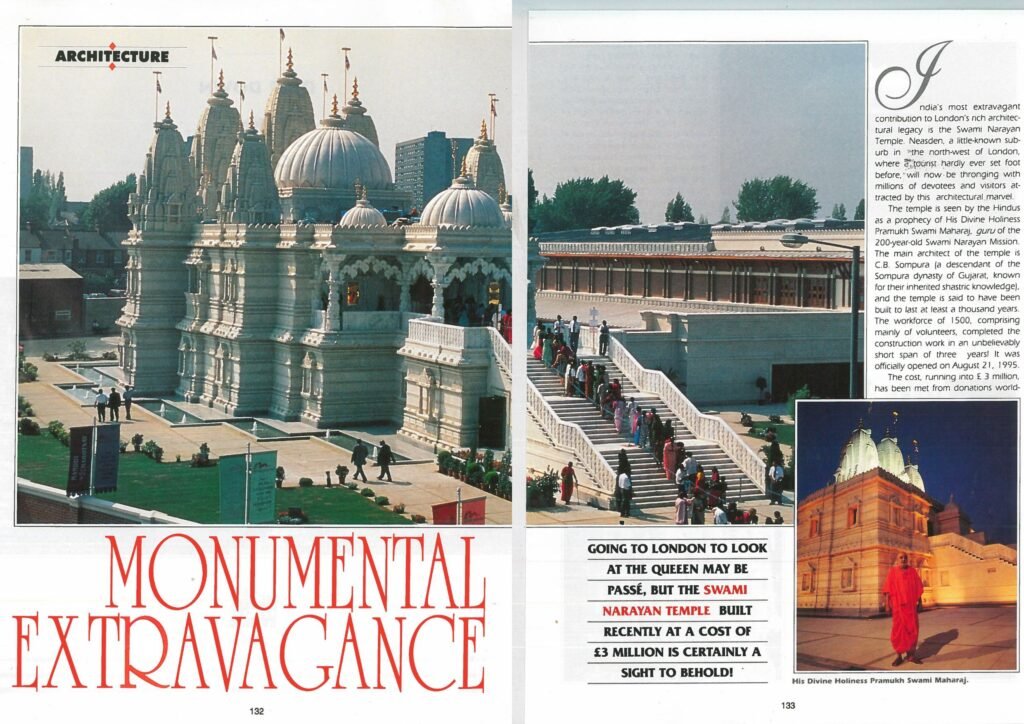
The mandir is situated at the first floor level, and is built of solid limestone from Bulgaria and Carrara marble from Italy. The processional pathway consists of a wide, external flight of marble steps. The marble from Italy was first shipped to Kandla, a port in Saurashtra, Gujarat, where the craftsmen did all the carving in a workshop. It was later transported to London, and fitted like a jigsaw puzzle. The heating system of the temple is concealed beneath the flooring.
The inner sanctum of the mandir has massive carved pillars depicting stories of the incarnation. These pillars support the four-metre-long solid stone beams above. As the temple authorities believe that steel would hamper meditation, it has been avoided in the construction. Even the six lotus-shaped domes of the temple are devoid of steel. The largest one in the centre is said to be Europe’s first cantilevered dome built without steel. It springs over a metre above the flat roof and has light wells hidden behind to give the impression of natural light.
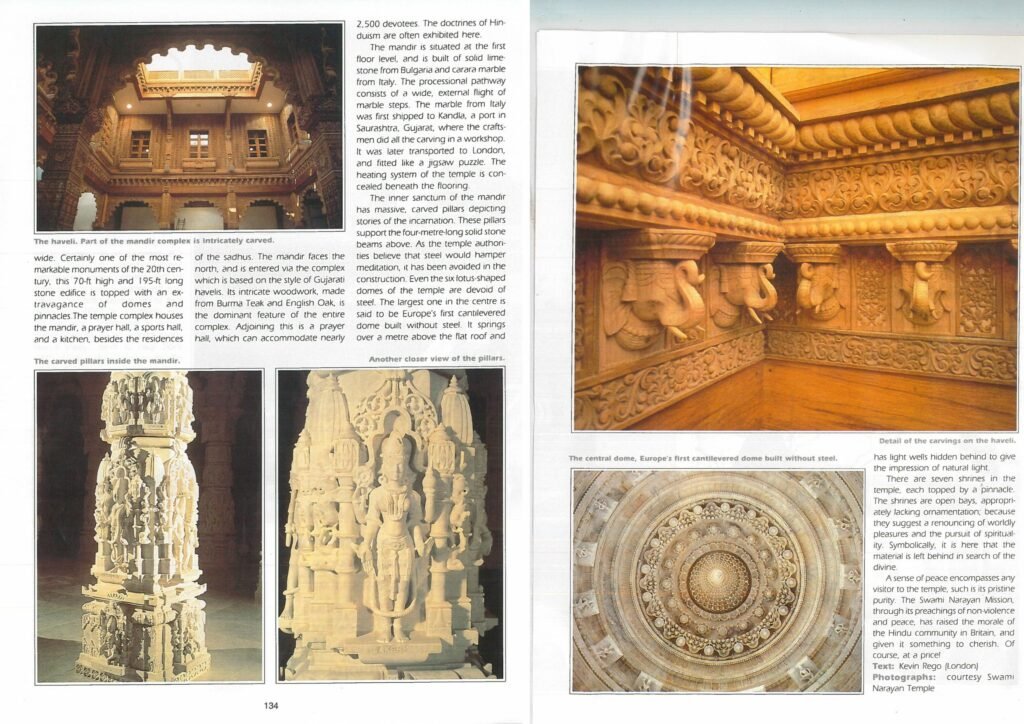
There are seven shrines in the temple, each topped by a pinnacle. The shrines are open bays, appropriately lacking ornamentation; because they suggest a renouncing of worldly pleasures and the pursuit of spirituality. Symbolically, it is here that the material is left behind in search of the divine.
A sense of peace encompasses any visitor to the temple, such is its pristine purity. The Swaminarayan Mission, through its preachings of non-violence and peace, has raised the morale of the Hindu community in Britain, and given it something to cherish. Of course, at a price!
Text: Kevin Rego (London)
Photographs: courtesy Swami Narayan Temple